
0.0%
of global GHG emissions
Livestock is a leading source of agricultural emissions and the dominant source of agricultural methane, driven by enteric fermentation.
TacklEmission is developing biodegradable nanoparticles that carry an enzyme against the methane-producing archaea in a cow's rumen, while leaving the rest of the microbiome it needs to digest food intact.
Built by a University of Queensland student team through the Australasian Synthetic Biology Challenge. The work is at an early research stage: enzyme expression and in vitro validation, not yet animal trials.
Supported by





Agriculture contributes about 14.5% of all global greenhouse-gas emissions. Methane from cattle is one of the largest near-term reduction targets, and one of the most tractable.
Livestock is a leading source of agricultural emissions and the dominant source of agricultural methane, driven by enteric fermentation.
Biogenic methane has 27× the global warming potential of CO₂ over a 100-year horizon (IPCC AR6), making it a priority for rapid reduction.
Each animal produces roughly 100–150 kg of methane per year via methanogenesis in the rumen (beef to dairy).
Enteric fermentation alone emits approximately 100 million tonnes of methane annually, representing a massive mitigation target.
Each existing mitigation approach carries limitations that prevent it from reaching the scale and reliability needed for global impact.
FutureFeed
Reported efficacy
80%+
DSM-Firmenich
Reported efficacy
~30%
Various
Reported efficacy
~50%
TacklEmission
Projected efficacy
30%+*
OUR APPROACH ↑
A five-step biological pathway from engineered nanoparticles to sustained methane reduction, without disrupting rumen ecology or animal productivity.
Step 1 of 5
Biodegradable polyhydroxyalkanoate (PHA) nanoparticles are manufactured using engineered microbial fermentation. PHAs are naturally occurring biopolymers that are biocompatible and metabolisable.
Technical parameters
50–500 nm diameter · Rumen-stable · Food-contact grade
A lac-regulated operon in E. coli BL21 stays silent until IPTG lifts the repressor. Transcription then yields the PHA biosynthesis enzymes, which build a bionanoparticle displaying the PeiR lytic enzyme on its surface.
The repressor occupies the operator. RNA polymerase binds the promoter but cannot clear it, so the operon stays silent.
phaA · β-ketothiolase — phaB · acetoacetyl-CoA reductase — phaC · PHA synthase (C-terminal PeiR fusion)
Four components that make the system specific to rumen methanogens and, if it works, manufacturable at scale. The same surface-display approach could later extend beyond enteric fermentation.
Biodegradable biopolymer nanoparticles engineered for rumen stability. Produced via scalable microbial fermentation. Biocompatible and metabolised post-action.
Pseudomurein endoisopeptidase R, a naturally occurring enzyme with intrinsic selectivity for the pseudomurein cell wall of the Methanobacteriales, primarily Methanobrevibacter, which constitute ~74% of rumen archaea. Literature-validated mechanism.
Genetic engineering tools to optimise the PHA production pathway, enzyme expression levels, and surface-display efficiency across iterative design cycles.
Microbial fermentation production enables cost-effective, large-scale manufacturing compatible with existing pharmaceutical and bioprocessing infrastructure globally.
Targets only methane-producing archaea, with no intended impact on beneficial rumen bacteria or animal health.
PHA is a biodegradable biopolymer, aiming to avoid chemical residues in meat, milk, or the environment.
Microbial fermentation is an established industrial process, so production can scale with established methods.
Aiming for less frequent dosing than daily chemical additives, which would reduce the burden on farmers.
The surface-display approach could be retargeted to other microbial targets in livestock health.
The livestock methane-mitigation market is expanding rapidly, driven by net-zero commitments, carbon pricing, and regulatory pressure on agriculture.
2024 global market
10-year outlook
2024–2034
* Revenue projections are indicative. TacklEmission intends to pursue multiple parallel revenue streams including feed additives, carbon-credit generation, and technology licensing.
Most current options are either chemical inhibitors or supply-chain-constrained extracts. A targeted, biodegradable nanoparticle sits apart from both.
FutureFeed founding round A$13M (~US$9.3M); ~US$29M raised to date. Funding figures reflect reported rounds and may lag latest raises.
Our approach is grounded in published research on PeiR enzyme activity, PHA nanoparticle engineering, and rumen methanogenesis biology.
Altermann et al., 2018
PeiR-displaying nanoparticles reduced methane by up to 97% in pure culture over five days, selectively lysing methanogenic archaea via pseudomurein cleavage.
Altermann et al., 2022
Scaled into a continuous-flow rumen model, the nanoparticles achieved a 5–15% methane reduction over 11 days. That gap between pure culture and a working rumen is what our project targets.
Henderson et al., 2015
Across 32 ruminant species, ~74% of rumen archaea are Methanobrevibacter. That is a small, conserved set of methanogens for a selective treatment to target.
Students across chemical engineering, molecular biology, synthetic biology, and computer science, working together at the University of Queensland.





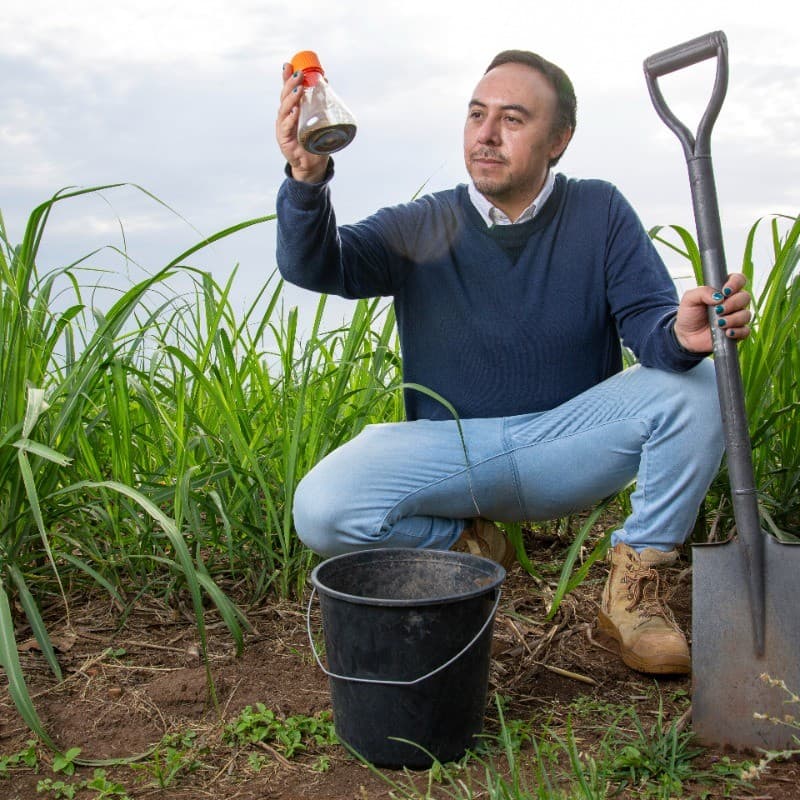
Supervisor
University of Queensland
These are the figures the project is aiming at, not results we have yet. If the additive works at scale, the reduction in agricultural methane would be large.
Per animal, per dosing cycle
Global livestock market opportunity
Versus CO₂ over 100 years (IPCC AR6)
Beyond direct methane reduction, a verified additive could let farmers take part in emerging voluntary carbon markets. Each tonne of CO₂-equivalent avoided can be monetised as carbon credits, which would add a revenue stream alongside the climate benefit.
Stay up to date with the latest awards, events and milestones from the TacklEmission team.
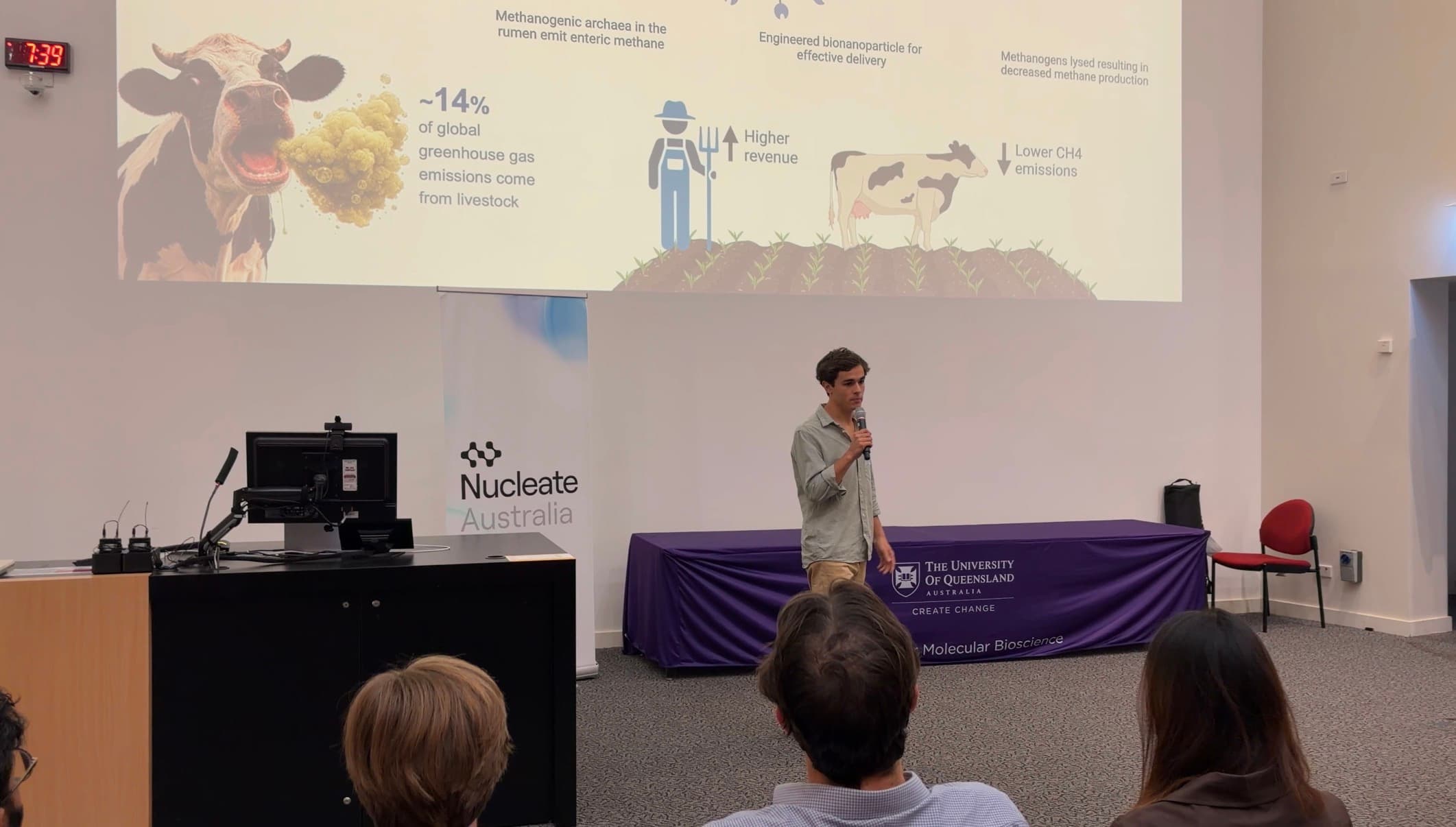
Felipe represented TacklEmission at Nucleate Australia’s Brisbane Reverse Industry Pitches and Student Elevator Pitch Competition, presenting our approach to tackling enteric methane through synthetic biology and long-duration delivery. We are incredibly excited to have placed second.
Beyond the competition itself, the night was a valuable chance to hear directly from industry leaders, investors and the broader biotechnology community about the challenges and opportunities shaping early-stage biotech.
A huge congratulations to Felipe for representing the team and delivering the pitch — another milestone as we keep developing and challenging the concept.
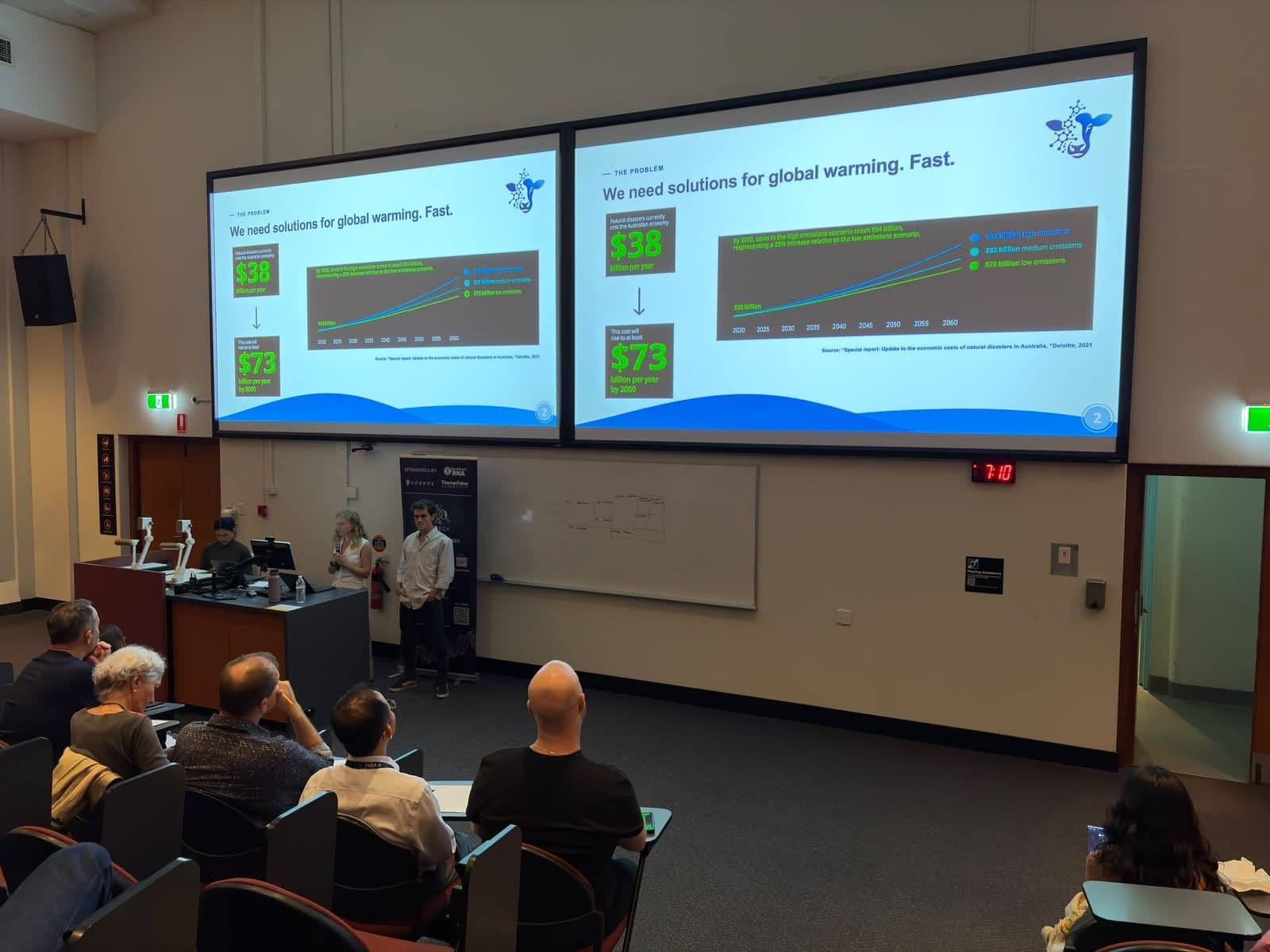
We are thrilled to share that TacklEmission received the Judges’ Choice Award at the UQ SynBio Pitch Night, hosted by the UQ Biotechnology Society.
Rachel Mueller and Felipe Victorica took the stage for TacklEmission, pitching our synthetic biology solution to one of the cattle industry’s most significant sustainability challenges: enteric methane emissions.
It was fantastic to present alongside the talented teams from Adhesyn, Melanosense and Pherosen, and to celebrate the innovative ideas being developed by UQ students. Thank you to everyone who attended, asked questions and supported the four UQ teams — we are grateful to be part of such an enthusiastic community of biotechnology innovators.
Next stop: the Australasian SynBio Challenge Finals in Sydney.
Whether you're an investor, research partner, industry collaborator, or just curious, we'd like to hear from you.